Anyway, since then the timberwolves ended up getting the second pick and twins have at least shown signs of sporadic improvement. So instead of that post, I will focus on what many have said is a "curse" for the timberwolves. That is, since the team began in 1989 the timberwolves have never once moved up to a better draft position than they were supposed to. Since we have ended up with the draft position exactly what we were seeded to have on a few occasions, we can't say we always drop. So for the sports writers who say our streak continued this year was completely trivial. Of course the streak continued, we had the top seed, dummy!
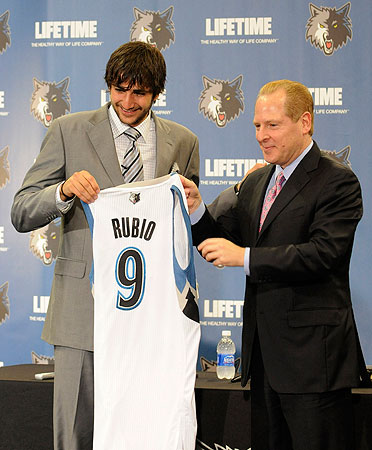
But, that still doesn't explain 22 years of draft history without moving up once. After accounting for the Joe Smith debacle, the years we didn't have a lottery pick because we actually made the playoffs, and the one lottery pick we got via trade (Ricky Ricky Ricky), we have had a total of 16 lottery picks.
Lottery History
Since 1990 the number of teams eligible for the lottery has increased from 11 to 14. Teams are assigned some probability of winning based on their regular season record. Once the first 3 spots have been determined, there is no longer any randomness. The team with the top seed that doesn't yet have a pick automatically receives the 4th pick. This continues until all 14 teams are assigned a draft spot. Therefore, if a team doesn't get a top three pick they automatically move down or stay the same. Also, not all teams in the top three picks will necessarily move up either. When you think about it that way, the probability of moving up is not that great for any team. Here are the probabilities of moving up from all 14 seeds in the 2011 draft.
| Seed | Probability of moving up |
| 1 | 0 |
| 2 | 0.199 |
| 3 | 0.313 |
| 4 | 0.378 |
| 5 | 0.291 |
| 6 | 0.215 |
| 7 | 0.151 |
| 8 | 0.1 |
| 9 | 0.061 |
| 10 | 0.04 |
| 11 | 0.029 |
| 12 | 0.025 |
| 13 | 0.022 |
| 14 | 0.018 |
From this, we can see it certainly isn't equally likely to move up or down. Your chances of moving up is also very dependent on what your seed is. At this point, I am going to wave my hand and ask you to trust me on these calculations for the Timberwolves draft history. I will include a technical section at the end if you wish to verify my work.
| Year | Seed | Probability of Moving Up | Pick |
| 1990 | 5 | 0.3329221 | 6 |
| 1991 | 7 | 0.23970483 | 7 |
| 1992 | 1 | 0 | 3 |
| 1993 | 2 | 0.1515 | 5 |
| 1994 | 3 | 0.3281 | 4 |
| 1995 | 3 | 0.36 | 5 |
| 1996 | 5 | 0.2589 | 5 |
| 1997 | no lottery | 0 | |
| 1998 | no lottery | 0 | |
| 1999 | 5 | 0.2949 | 6 |
| 2000 | no lottery | 0 | |
| 2001 | no lottery | 0 | |
| 2002 | no lottery | 0 | |
| 2003 | no lottery | 0 | |
| 2004 | no lottery | 0 | |
| 2005 | 14 | 0.0181 | 14 |
| 2006 | 6 | 0.1828 | 6 |
| 2007 | 7 | 0.183 | 7 |
| 2008 | 3 | 0.2804 | 3 |
| 2009 | 2 (From Washington) | 0.178 | 5 |
| 2009 | 5 | 0.2549 | 6 |
| 2010 | 2 | 0.199 | 4 |
| 2011 | 1 | 0 | 2 |
These probabilities come from this site (sort of), but whoever did the site clearly has the probabilities wrong from 1990-1994. Anyone know why?......write a comment! From 1994-2009 I checked his or her work and they seem ok. The moral of the story is,
1. Each year it is more likely the Timberwolves will not move up in the draft.
2. They have been getting unlucky, but not that unlucky. The probability that in the 16 lotteries that the T-wolves would never move up is about 2.2%. Britt's great uncle Fritz was struck by lightning twice (Probability 0.0000000001625%)... Seriously. I would say crazier things have happened than the Timberwolves failing to move up for 16 drafts.
3. Never moving up is a bummer, but we should have only expected to move up in about 3 drafts by now.
4. If we didn't finish dead last we would have had a much higher chance of moving up in the draft.
Anyway, thanks for reading. Most of you can safely stop reading at this point unless you care about checking my work.
Technical Portion
Let D1 be a random variable defined by the the team that wins draft position 1. D2 position 2 and so on. Let t be in {1,2,...14} if there are 14 eligible teams in the draft. Let b_t be the number of balls seed t has in pot. Then, for example
P(D1=1) = b_1/ sum_{t=1}^14 b_t
P(D2=1) = P(D2=1|D1=2)P(D1=2) + P(D2=1|D1=3)P(D1=3) +...+ P(D2=1|D1=14)P(D1=14)
P(D3=1)= P(D3=1|D1=2,D2=3)P(D2=3|D1=2)P(D1=2)+ ...+P(D3=1|D1=13,D2=14)P(D2=14|D1=13)P(D1=13)
This needs to be summed for all D1 and D2 pairs that are not equal to each other. I won't spend a ton of time writing this out, because if you can follow this you should be able to see what this looks like via these two R function.
balls2=c(250,199,156,119,88,63,43,28,17,11,8,7,6,5)
##calculates probability of getting second pick for any seed
pballs=c()
calc=function(seed){
set=(1:length(balls2))[-seed]
for(i in set){
pballs[i]=balls2[i]/(sum(balls2)-balls2[i])
}
ans=sum(pballs[set])*(balls2[seed]/sum(balls2))
return(ans)
}
##calculates probability of getting third pick for any seed
pballs2=matrix(NA,length(balls2),length(balls2))
calc2=function(seed){
set=(1:length(balls2))[-seed]
for(i in set){
for(j in set){
pballs2[i,j]=(balls2[seed]/(sum(balls2)-balls2[i]-balls2[j]))*(balls2[i]/(sum(balls2)-balls2[j]))*(balls2[j]/sum(balls2))
}
}
diag(pballs2)=NA
ans=sum(pballs2[!is.na(pballs2)])
return(ans)
}
You can check your results on the wikipedia draft lottery page.

Good stuff! Still, since there's a slightly better than 2% chance that they wouldn't have moved up at least once by now, that means there's a 98% chance they should have - I'd say that's unlucky, although you're right, it's not quite unbelievably so.
ReplyDeleteMichael - With the recent State Shutdown, I have been concerned about my job security and retirement. So I plan on taking matters into my own hands and buying Powerball tickets with my paycheck (after bills, of course). This will ensure millions by the time I retire, right?
ReplyDeleteBut that is not my question. My plan may be perfectly timed as I just read an article that Powerball tickets are going up from $1/ticket to $2/ticket. The article said my odds of winning would now be increased but with the pot remaining large enough for retirement. How could this be true, Michael? Tell me the odds! (oh, and if I do win, should I take the lump sum or steady checks over the rest of my life?)